
By Ananya M
3rd sem BCOM LLB
For many salaried employees, the deduction marked “PF” on a salary slip may seem like just another reduction in take-home pay. But behind that monthly deduction is a system designed to provide financial security long after the monthly salary stops.That is why the recent revision of the Employees’ Provident Fund Organisation (EPFO) wage ceiling matters.
The Central Government has increased the statutory wage ceiling for mandatory EPFO coverage from ₹15,000 to ₹25,000 per month, effective 17 September 2026. The Government expects the change to bring more than 51 lakh additional employees into the social-security framework.
But what does this mean for an employee earning between ₹15,000 and ₹25,000? And how could it affect their salary, savings and retirement?
What is the EPFO wage ceiling?
The EPFO administers important social-security schemes including the Employees’ Provident Fund (EPF), Employees’ Pension Scheme (EPS) and Employees’ Deposit Linked Insurance Scheme (EDLI).
The wage ceiling determines the salary level up to which mandatory EPFO coverage applies, subject to the applicable statutory conditions.The previous ceiling of ₹15,000 per month had remained unchanged since September 2014. Under the revised framework, eligible employees earning between ₹15,000 and ₹25,000 can now come within mandatory EPFO coverage.
In simple terms, a worker who previously earned slightly above ₹15,000 and therefore fell outside mandatory coverage solely because of the wage ceiling may now enter the social-security system, provided the other applicable conditions are satisfied.
What changes for an employee?
Consider a simple illustration.
Suppose an employee’s wages for EPFO purposes are ₹15,000. At a 12% employee contribution, the monthly employee contribution would be:
12% of ₹15,000 = ₹1,800
If the applicable contribution base becomes ₹25,000:
12% of ₹25,000 = ₹3,000
This means that, in an illustrative calculation, the employee’s monthly contribution increases by ₹1,200.
Illustrative EPFO contribution comparison
Monthly employee and employer contribution amounts when the contribution base rises from ₹15,000 to ₹25,000.
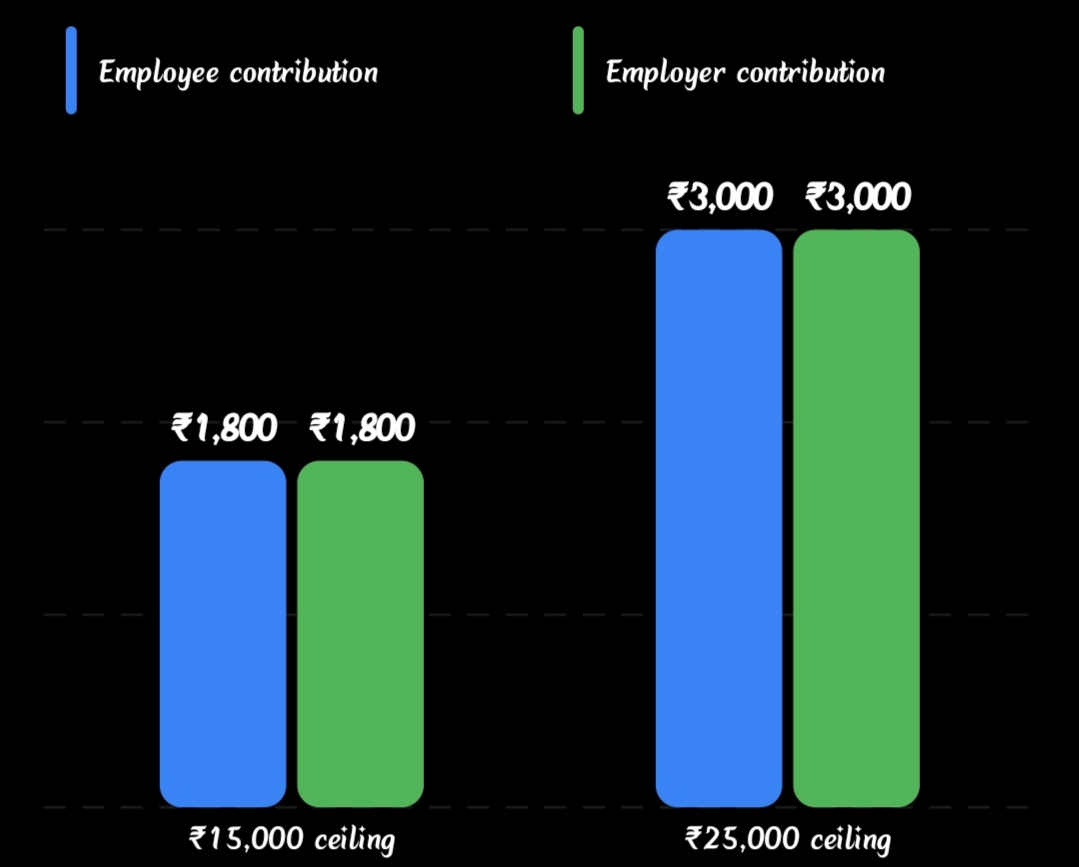
Illustration based on a 12% contribution assumption. The employer’s share is distributed according to applicable EPFO scheme rules; it is not necessarily credited entirely to the employee’s EPF account.
Figure 1: Illustrative comparison of monthly employee and employer contributions at the earlier and revised wage ceilings.
The graph shows the basic effect of increasing the contribution base. However, the actual amount credited to different EPFO components depends on the applicable provisions and salary structure. The employer’s contribution is not simply deposited entirely into the employee’s EPF balance; part of it may go towards the pension component under EPS.
A wider social-security net
The biggest significance of the change may not be the additional ₹1,200 contribution illustrated above. It is the expansion of social-security coverage.According to the Government, more than 51 lakh additional employees are expected to come within the EPFO framework because of the revision.
For these employees, EPFO coverage can mean access to three important forms of protection:
Provident Fund: long-term retirement savings.
Pension: benefits under the Employees’ Pension Scheme, subject to applicable rules.
Insurance: protection under the Employees’ Deposit Linked Insurance Scheme.This makes the change particularly relevant for workers who are entering formal employment and may not otherwise have structured retirement savings.
What about pension?
The revision also affects the pension component.Government information indicates that, where applicable, the maximum EPS contribution is calculated at 8.33% of the revised ₹25,000 ceiling, rather than 8.33% of ₹15,000.
That means the maximum pension contribution under this calculation rises from approximately ₹1,250 to ₹2,083 per month.Over years of employment, such changes can become significant because retirement savings are built gradually through regular contributions.
What does this mean for employers?
The change is not relevant only to employees.
Employers will also have to account for the revised ceiling when handling payroll, EPFO enrolment and contribution-related compliance for eligible employees.
For an organisation employing a large number of workers in the ₹15,000–₹25,000 wage range, the increased contribution base can affect monthly payroll costs.At the same time, formal social-security coverage can provide employees with greater financial protection and may contribute to a more structured employment relationship.
The Government has also linked the broader employment policy framework with incentives for eligible establishments creating additional employment under the Pradhan Mantri Viksit Bharat Rozgar Yojana (PMVBRY), subject to the scheme’s conditions.
A benefit today or a burden today?
There is an interesting balance here.
For an employee, a higher PF contribution can mean slightly lower disposable income today. Someone looking at their monthly salary may naturally focus on what is deducted.But the same contribution represents money being directed towards long-term financial security.
For example, an employee may prefer an additional amount in their bank account today to meet immediate expenses. Another may value having a larger retirement corpus and pension protection in the future.The impact will therefore differ from person to person depending on salary, expenses, age, existing savings and financial priorities.
Looking beyond the salary slip
The revision of the EPFO wage ceiling is more than a change in a number from ₹15,000 to ₹25,000.It reflects a broader question: How should social-security protection keep pace with changing wages and the realities of formal employment?
The previous ceiling was introduced in 2014. Since then, wages, employment patterns and household expenses have changed considerably. The revised ceiling brings a larger section of employees within the statutory social-security framework. For a young employee receiving their first salary, retirement may seem decades away. But financial security is rarely created overnight. It is built through small, regular contributions over many years.
Conclusion
The increase in the EPFO wage ceiling from ₹15,000 to ₹25,000, effective 17 September 2026, expands mandatory social-security coverage to a wider group of eligible employees.
For employees, it can mean greater access to provident fund savings, pension and insurance protection. For employers, it means adapting payroll and compliance processes to the revised ceiling.Ultimately, the significance of the reform goes beyond the amount deducted from a salary every month.
What appears on a salary slip today may become a source of financial security tomorrow.
Source
Press Information Bureau, Ministry of Labour & Employment, Government of India — Cabinet approves higher EPFO wage ceiling of ₹25,000, expanding mandatory coverage, 16 September 2026.
Press Information Bureau